
The article argues that where to go birding in the Waterberg is less about compiling a list of birding sites and more about choosing the right place to stay. It presents Waterberg Cottages as a convenient central base that provides immediate access to productive birding habitats while also making it easy to explore important regional sites such as Nylsvley Nature Reserve. The Waterberg’s varied landscapes—including bushveld, rocky areas, and seasonal wetlands—allow birders...
The Winter Sky at Waterberg: A Stargazing Experience Like No Other
Posted on Sun May 10, 2026.
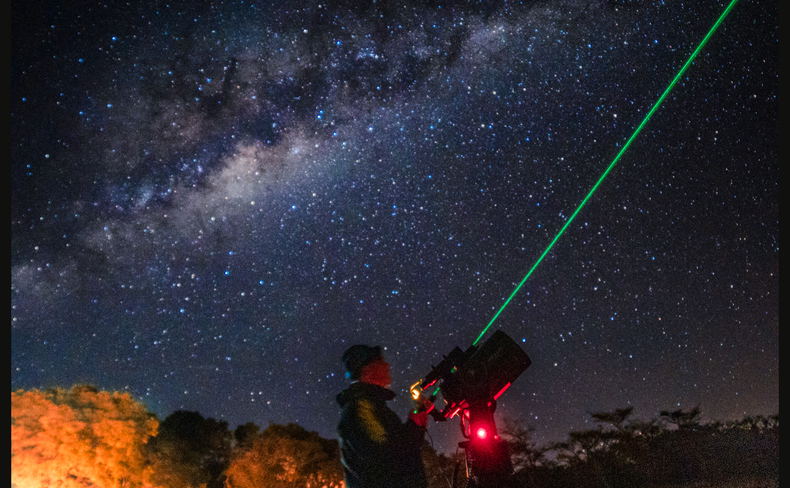
When the summer rains fade and the Waterberg air turns crisp, something extraordinary happens overhead. From April through September, the skies above this private 2,500-hectare reserve become a window into the southern Milky Way: dark, clear, and far from city light. Join physicist Dr Philip Calcott for an intimate evening under the stars: lying on mattresses, wrapped in blankets, as he guides you through constellations, nebulae, and galaxies visible to the naked eye. It’s not a lecture; it’s a conversation with someone who has spent a lifetime in love with the cosmos. June and July fill fast. Book your winter stay before the best nights go.
THE SKY WAKES UP IN WINTER
This is why the Waterberg's dry season is the best time to look up.
There's a moment that happens every year around May, when the last of the summer rains fades and the Waterberg air turns crisp and dry. The dust settles. The humidity drops. And the night sky, already extraordinary on this private 2,500-hectare reserve, becomes something else entirely.
If you've never experienced a truly dark sky, it's difficult to describe. The Milky Way doesn't just appear as a faint smear - it arches overhead like a river of light, dense and three-dimensional, as if you could reach up and stir it. This is what winter brings to the Waterberg. And from now until the first rains return in October, our evenings are among the most spectacular on the subcontinent.
WHY WINTER CHANGES EVERYTHING
South Africa's highveld winter is famously clear. Cold fronts sweep moisture away, cloud cover becomes rare, and the Waterberg's distance from city light pollution means there's almost nothing between you and the cosmos. On a good winter night here, the naked eye can resolve individual stars in clusters that most people only ever see in photographs.
But it's not just clarity. The winter sky itself rotates into position to show off its most dramatic features. The galactic centre of the Milky Way - that densest, most luminous core - sits high in the southern winter sky, positioned almost directly overhead on long June nights. Orion makes its exit, and in its place come Scorpius, Sagittarius, and the stunning star-forming regions of the southern Milky Way.
- WATERBERG COTTAGES, GUEST FEEDBACK
"Guests of all ages consistently rate the Philip’s Star Show as the most memorable experience of their stay.”
DR PHILIP CALCOTT: A SHOW UNLIKE ANY OTHER
What makes the astronomy experience here unique isn't just the sky - it's the guide. Dr Philip Calcott is a physicist who has spent decades making the universe accessible to everyone from school children to the contestants of Miss World to packed cricket stadiums. But his most intimate performances happen right here, under the Waterberg stars.
You'll lie on mattresses under the open sky, wrapped in blankets with a hot water bottle at your feet, while Dr Calcott uses a high-powered laser to trace constellations, point out planets, and navigate you through nebulae and galaxies visible to the naked eye. He has a gift for making the incomprehensible feel personal; by the end of the evening, the sky above you feels like somewhere you know.
It's not a lecture. It's closer to a conversation with someone who has spent a lifetime in love with the cosmos, and can't wait to share it with you.
WINTER STARGAZING SEASON AT WATERBERG
April - Rains thinning. Skies clearing. Season begins.
May - First reliably clear nights. Milky Way rising.
June - Peak clarity. Galactic core overhead. Best month.
July - Long, cold, crystal-clear nights. Spectacular.
August - Warm days, clear evenings. Scorpius prominent.
September - Still clear. Spring wildflowers beginning.
WHAT YOU'LL SEE ON A WINTER NIGHT
For first-time visitors to a dark sky site, the experience is genuinely disorienting - in the best possible way. Here's some of what becomes visible on a clear Waterberg winter night:
The Milky Way Core - The galactic centre of our galaxy, visible as a dense, cloud-like band arching across the sky. June and July are the best months.
The Southern Cross - Crux, invisible from most of the northern hemisphere, is a winter fixture used for millennia by southern navigators.
Antares & Scorpius - The scorpion dominates the winter sky, its red heart — Antares, a supergiant 700 times the size of our sun - glowing unmistakably.
Star Clusters & Nebulae - The Jewel Box, Omega Centauri, and the Eta Carinae Nebula are all visible to the naked eye from a dark sky site.
Planets - Jupiter and Saturn are prominent in the winter evening sky in 2026. Saturn's rings are visible through even a modest telescope.
The Magellanic Clouds - Two dwarf galaxies, satellite galaxies of the Milky Way, visible as misty patches to the naked eye - unique to southern skies.
AN EVENING WORTH PLANNING AROUND
Many guests book a return visit to Waterberg specifically to catch the star show again — this time with more knowledge of what they're looking at. We'd recommend booking mid-week during the new moon phase, when there's no lunar interference and the sky reaches its full, almost unbelievable depth.
After the show, there's usually a fire, a good glass of wine, and a quietness that's hard to find anywhere else. The kind of quiet where you can hear jackals calling across the reserve and, if you're lucky, a distant lion making its presence known.
The Waterberg at night is something the subcontinent does better than almost anywhere else. This winter, we'd love to share it with you.
PRACTICAL NOTES
The star show runs on clear evenings and is bookable for guests staying on the reserve. Dr Calcott's availability should be confirmed at the time of booking. Bring warm layers - winter nights in the Waterberg drop sharply after sunset, and you'll want to be comfortable lying out under the sky.
Book now at info@waterbergcottages.co.za or call +27 (072) 345-4854
Boschdraai Farm, Vaalwater, Limpopo · 2.5 hours from Pretoria
Further Reading
Where to go birding in the Waterberg
Tue September 29, 2026
Read This Article
Birding in the Waterberg
Sat August 15, 2026
Read This Article
The Waterberg region in South Africa offers a slow-paced, atmospheric birding experience where patience and micro-habitat immersion take priority over fast-paced checklists. Unlike busier reserves, its landscape shifts continuously between broad-leafed bushveld, rocky outcrops, dry woodlands, and reed-fringed wetlands, creating distinct birding experiences across the seasons. Summer brings vibrant migratory species and active breeding behaviors, while winter's thinner canopy provides clear visibility for tracking woodland birds and soaring raptors. Choosing an accommodation...
Why Waterberg is the Perfect Long Weekend Escape
Mon April 7, 2025
Read This Article
Looking for a peaceful escape that's just a few hours' drive from Johannesburg or Pretoria? The Waterberg is your answer - and Waterberg Cottages is the perfect place to unwind.
Share This Post